
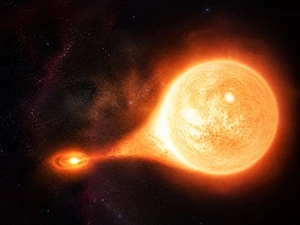
NASA Tracks a Giant Star Swallowing Its Smaller Neighbor
Erin Calloway
Updated Nov 23, 2026
Astronomers have reconstructed a rare cosmic event in which a giant, aging star swallowed a smaller companion. The dramatic collision took place in the Andromeda galaxy, and researchers followed its brightening over years before using NASA’s James Webb Space Telescope to examine the aftermath. Their findings, published November 18, provide one of the clearest views yet of a long-predicted stage in stellar evolution.
The research team nicknamed the system Bao. There were originally two stars: a massive one expanding late in life and a smaller neighbor caught in its outer layers. The little star spiraled inward over years, losing energy as it moved through the larger star’s envelope, until the system erupted.
A strange brightening becomes a cosmic clue
Viraj Karambelkar, the study’s lead author and a NASA Hubble Fellow at Columbia University, said researchers first noticed unusual activity in 2023 and kept watching. The team later used older telescope records to piece together the earlier stages, including gradual brightening that began years before the final event.
The giant star had roughly seven times the Sun’s mass and an estimated radius about 350 times larger, according to NASA’s reconstruction. Its companion was estimated at about seven-tenths of the Sun’s mass. The size difference explains why the smaller star did not simply bounce away from the giant’s swollen atmosphere.
By the end of 2025, observers recorded a luminous eruption. Webb viewed the object only 47 days after the brightness peak, an unusually rapid follow-up that allowed scientists to examine the dust and material thrown off as the stars merged.
Why Webb changed the interpretation
The James Webb telescope is especially sensitive to infrared light, which can reveal warm dust that hides details from ordinary visible-light observations. Its measurements helped researchers match the observed event to computer models of a smaller star spiraling toward the core of its enormous partner.
This is the process astronomers call common-envelope evolution. A growing star can engulf an orbiting companion, causing friction inside the shared envelope. That energy can change the orbit dramatically and expel some of the outer material. Scientists had modeled such events for years, but following an actual system through its major stages was much harder.
The team’s model indicated that the companion was drawn inward instead of escaping. NASA described the event as an explosive merger that scattered material into space. Researchers also cautioned that future observations would help clarify how the remaining star settles after losing part of its outer layers.
A seven-year approach to one collision
The research reconstructs the smaller star entering the outer envelope of the giant around 2018 and spiraling inward over roughly seven years. Light from the system changed over that period before the bright eruption observed in 2025. Rather than catching a single frame of a sudden impact, scientists assembled a time sequence from different instruments and older surveys.
The published paper estimates that the merger expelled a fraction of the giant star envelope at high speeds. Matching that released material to theoretical models helps scientists understand how orbital energy moves through gas surrounding the two stars. The same process is thought to influence which paired stars become tight binary systems later in their lives, so one distant eruption can inform the modeling of many others.
A rare look at what stars do to each other
Many stars live in pairs, meaning interactions like this can shape the universe’s population of future compact objects. Observations of Bao offer evidence that can sharpen calculations about what happens when stars share an envelope and rapidly change each other’s orbits.
The bright point seen by telescopes is not a close-up photograph of two recognizable star shapes colliding. It is a distant astronomical signal reconstructed using years of measurements, infrared data and physical modeling. What is extraordinary is that scientists could follow enough of the sequence to test how such a collision happens, rather than only infer it from the aftermath.
References: NASA Data Clinches First-of-Its-Kind Stellar Merger | An inspiral of a star inside a common envelope with its giant companion | Columbia Researchers Spot First-of-Its-Kind Stellar Merger

AI-Assisted Content
The News And Beyond team was assisted by generative AI technology in creating this content.
Trending


Usher Seeks $700,000 He Says a Business Owes Him
Caption: Usher at the Cannes Film Festival, May 2016. Credit: Georges Biard / CC BY-SA...
Emily Carter


Baron Davis Fights Sister Over a House He Says He Owns
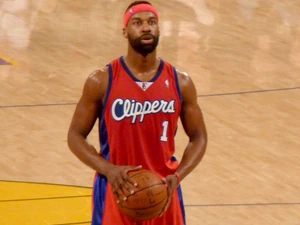
Caption: Former NBA player Baron Davis shooting a free throw, January 2010. Credit: MavsFan28 /...
Susan Blake
A Judge Blocked Groundbreaking on Trump's 250-Foot Arch
President Donald Trump's proposed 250-foot memorial arch has won a key federal planning approval, but...
Erin Calloway

Toys R Us Returns With More Than 160 Stores
Caption: Toys R Us store in Allen, Texas, November 2026. Credit: Zalkana / CC BY-SA...
Erin Calloway
Hilary Swank, Pregnant at 52, Tells Critics to Get With the Times
Caption: Hilary Swank at the 2015 Tokyo International Film Festival. Photo: Dick Thomas Johnson /...
Susan Blake


IRS Raises the 2027 Standard Deduction to $33,200
Married couples filing jointly will have a standard deduction of $33,200 for tax year 2027,...
Alex Mercer


Paul Pierce Disputes $8,508 Child Support Complaint
Caption: Paul Pierce playing for the Washington Wizards, February 2015. Credit: Keith Allison / CC...
Emily Carter

Dorit Kemsley Finds a New Home After $7 Million Mansion Dispute
Caption: Dorit Kemsley in a 2016 video still. Photo: The Street Interviewer / Wikimedia Commons....
Susan Blake

Amy Robach and T.J. Holmes' Exes Share Wedding Photo
Andrew Shue and Marilee Fiebig have shared the first public photograph from their wedding, following...
Susan Blake

New Food Aid Proposal Could Affect Millions of Families
The Trump administration has proposed tightening the rules used to qualify households for food assistance,...
Thomas Hale