Why Balance Training Matters More Than Fitness Level
By Emily Carter. Jan 7, 2026
A Surprising Predictor of Long-Term Health
Medical research is arriving at a consistent conclusion: balance ability is a stronger predictor of independence and longevity than overall fitness level. A person’s ability to maintain stability predicts their ability to stay independent, avoid falls, and maintain quality of life more reliably than how far they can walk or how much they can lift.
Falls are the leading cause of injury-related death in older adults and the most common trigger of loss of independence. Many of these falls are preventable. Yet balance work often gets overlooked in discussions about healthy aging because it doesn’t feel like traditional exercise-there’s no sweat, no equipment, and no visible exertion. That invisibility is precisely the problem.
Why Starting Early Is the Key
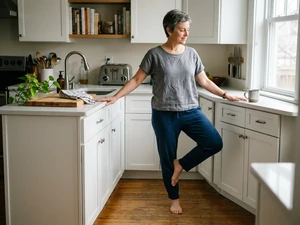
Research published in the British Journal of Sports Medicine recommends that people begin balance training in their 60s and 70s-before problems develop. This preventive approach is far more effective than trying to regain balance after it has already declined. A simple exercise like the single-leg stand-holding the position for 10 to 20 seconds, then switching legs-requires no equipment and no gym membership.
Research cited by Stanford demonstrates that people aged 51 to 75 who could stand on one leg for just 10 seconds showed meaningfully improved survival rates compared to those who could not. The relationship between balance ability and long-term health outcomes is not complicated-but it is underappreciated.
Practical Balance Exercises Anyone Can Do
Balance training doesn’t require special equipment or classes. A person can hold onto a kitchen counter while standing on one leg, use the corner of a room for support, or practice simple weight-shifting movements at home. The key is consistency and gradual progression as confidence builds.
Physical therapists also recommend the corner stand: standing with feet together and back toward a corner, both hands lightly on the walls, then closing the eyes to challenge balance without risk. These exercises are safe and accessible for all fitness levels, and they work because they engage the nervous system’s ability to detect and respond to position changes.
The Real Outcome: Staying in Control
The benefit of balance training doesn’t show up on a scale or in a fitness test. It shows up in the ability to walk confidently on uneven pavement, get up from a chair without hesitation, and move through daily life without the fear of falling that quietly limits so many older adults.
Balance training is one of the most practical investments in independence available-and one of the least complicated. The earlier it starts, the more it protects.
References: Healthy Habits For Successful Aging 60S And 70S

The News And Beyond team was assisted by generative AI technology in creating this content
Trending