Why Some Private Colleges Are Now Facing Closure Risk
Erin Calloway
Updated May 10, 2026
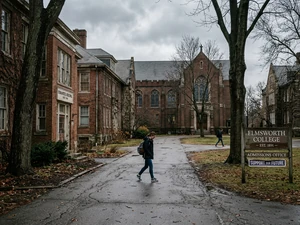
Colleges and universities have weathered enrollment fluctuations, budget pressures, and demographic shifts before. What higher education analysts and institutional leaders are describing in 2026 is something different: a convergence of pressures arriving simultaneously across revenue, enrollment, policy, and demographics in a way that is straining even institutions that have operated for generations.
How Many Institutions Are at Risk
NPR reported in April 2026 that more than a quarter of private colleges are at risk of closure, citing an analysis by EAB, a higher education consulting firm, that found every major revenue stream and expense category is under simultaneous pressure for the first time. An American Council on Education survey found that 86 percent of college and university leaders are worried about their institution’s long-term financial viability. Nearly a third of private nonprofit colleges posted operating deficits in 2024, according to research by the University of Tennessee’s Robert Kelchen.
A fifth of college and university presidents told Hanover Research and Inside Higher Ed they had engaged in serious discussions about merging with another institution - a figure that reflects how urgently leaders are already exploring structural options.
The Demographic Factor
The Western Interstate Commission for Higher Education projected that 2026 would mark the peak of the current high school graduate cohort, after which the number of traditional-college-age students is expected to begin a sustained decline. That trend - sometimes called the enrollment cliff - reflects birth rate patterns from the mid-2000s that are now arriving at college admission offices.
For tuition-dependent private colleges that lack large endowments or strong brand recognition, a smaller applicant pool intensifies competition in ways that can produce rapid financial deterioration. The effect is not uniform: community colleges and some public universities have seen growth from dual enrollment programs and career-focused students, while small residential liberal arts colleges face the steepest pressure.
Federal Policy and International Students
International enrollment has historically served as a financial buffer for institutions that charge full tuition to students from abroad. Federal restrictions on student visas and the widely covered conflict between the Trump administration and Harvard University - which involved an attempt to revoke the university’s ability to enroll international students, later blocked by a federal judge - created broad uncertainty across the sector about international enrollment pipelines.
Fitch Ratings characterized the 2026 outlook for higher education as ‘deteriorating’ in a February report, specifically citing the fragility of the international student revenue stream as an area of growing concern for tuition-dependent institutions.
What Closure Means for Communities
When a college closes, the effects extend well beyond students and faculty. Small-college towns often built significant portions of their local economy around the institution - employment, housing demand, retail, services, and civic identity. NPR noted that Cengage Group research found humanities and social sciences faculty are most likely to see their programs cut, and that institutions are increasingly adding short-term credentials and online offerings to compete for a broader pool of students.
For students already enrolled when an institution begins to show signs of financial stress, the uncertainty about degree completion, credit transferability, and institutional support is a practical concern that arrives without warning. The question of how to manage that transition - and what safety net exists for affected students - is one that state governments and accreditors are still working to answer.
References: Many Private Colleges At Risk Of Closing | 807222

AI-Assisted Content
The News And Beyond team was assisted by generative AI technology in creating this content.
Trending


More Holiday Shoppers Will Use AI to Hunt for Deals
More holiday shoppers plan to use AI to find gifts and compare prices, but most...
Alex Mercer


Senate Advances Energy Bill as Power-Cost Fight Intensifies
A 73-25 Senate vote has opened debate on an energy bill aimed at speeding construction...
Erin Calloway

Kim Kardashian's $148 Holiday Calendar Backfires as Skims Offers Refunds
Caption: Kim Kardashian attends a red carpet event in Sydney, Australia, on September 19, 2012....
Susan Blake
Nvidia CEO Affair Raises Questions About Alleged China Spy
Caption: Nvidia CEO Jensen Huang speaks at Stanford University on April 30, 2026. Credit: Anders...
Erin Calloway

Usher Seeks $700,000 He Says a Business Owes Him
Caption: Usher at the Cannes Film Festival, May 2016. Credit: Georges Biard / CC BY-SA...
Emily Carter

Inflation Tops Forecast as Groceries and Housing Squeeze Budgets
Groceries and housing pushed October prices up more than economists expected, adding pressure to everyday...
Daniel Reeves

Golden Trump Statue on National Mall Targets His Draft Deferment
A gold-colored statue of Donald Trump rubbing his bare foot has appeared on the National...
Thomas Hale


Johnny Depp Returns to Hollywood With a Scrooge Reinvention
Caption: Johnny Depp at the Berlin International Film Festival on February 21, 2020. Credit: Harald...
Emily Carter

IRS Raises the 2027 Standard Deduction to $33,200
Married couples filing jointly will have a standard deduction of $33,200 for tax year 2027,...
Alex Mercer
Dolly Parton Estate Ends Nephew Lawsuit but Door Remains Open
Caption: Dolly Parton in a 1977 RCA Records publicity portrait. Credit: David Gahr / Public...
Emily Carter